How to Read Animal Tracks Like a Backcountry Detective

Why Do Some Hikers Always Spot Wildlife While You See Nothing?
You have been walking the same trail for an hour—birdsong in the canopy, the rustle of small mammals in the understory—and yet you have not seen a single deer, fox, or even a rabbit. Meanwhile, that quiet figure ahead of you on the path keeps pausing, pointing, whispering about recent activity you completely missed. What do they know that you do not? The difference often comes down to track awareness—the ability to read the stories written in mud, snow, sand, and forest duff. Animal tracks are everywhere once you train your eyes to see them, and they reveal far more than just which species passed through. A single set of prints can tell you when an animal was here, how fast it was moving, whether it was hunting or being hunted, and even its emotional state. This skill transforms a routine hike into an ongoing mystery—one where you are the detective piecing together clues left by the local wildlife.
Learning to read tracks is not about memorizing every possible print pattern. It is about understanding the context—substrate, gait, pressure releases, and sign association. A deer track in soft mud looks different from the same track in crusted snow. A fox moving at a trot leaves a very different pattern than a fox stalking prey. The good news? You do not need years of wilderness training to begin. With a few foundational principles and some practice in your local greenspace, you will start noticing details that have always been there—hidden in plain sight.
What Basic Track Characteristics Should You Look For First?
Before you can identify which animal made a track, you need to observe how the track presents itself. Start with the basics: count the toes. Most mammals in North America fall into clear groups based on toe number. Canines, felines, and deer all show four toes on each foot. Rabbits and squirrels display four toes on the front feet and five on the rear. Bears, raccoons, and members of the weasel family typically show five toes on all feet. This simple count immediately narrows your possibilities.
Next, check for claw marks. Cats retract their claws when walking, so you will rarely see claw marks in feline tracks. Dogs, foxes, and coyotes cannot retract their claws, so their prints usually show small punctures ahead of the toe pads. The exception? Deep mud or slippery surfaces where even cats might extend claws for traction. Deer, being hooved animals, leave a completely different impression—two pointed halves that look nothing like paw prints.
Size matters too, but not in isolation. A large domestic dog and a coyote can leave similarly sized tracks. Look at the overall shape and symmetry. Dog tracks tend to be more rounded with toes splayed outward. Coyote and fox tracks are more oval, with toes pointing forward in a tighter line. The negative space between toes and pads tells a story—canines often show an X-shaped negative space between the toes and the large heel pad, while felines show a C-shaped or lobed negative space.
Study the gait pattern. Animals moving at different speeds leave different track arrangements. A walking deer leaves paired prints—front and rear feet landing close together. A running deer might show extended straddle and deeper impression in the front hooves. Predators like foxes often move in a direct register trot—rear feet landing exactly where front feet did—creating a straight line of tracks that looks almost mechanical. Understanding gait helps you reconstruct what the animal was doing when it passed through.
How Can You Tell How Recently an Animal Passed By?
Freshness matters. A crisp, sharp-edged track with defined details tells you the animal was here recently. Weather erodes tracks quickly—rain softens edges, wind fills impressions with debris, sun bakes mud into cracked clay. In snow, look at the track's bottom. If it shows crystalline sparkle or soft texture, it is fresh. If the bottom looks glazed, icy, or compacted, the track has aged—sun and wind have worked on it overnight or longer.
Substrate tells you even more. A track in firm, damp sand along a creek might last for days. The same track in dry, loose duff could disappear within hours. Learn to read the ground itself. Moisture content, vegetation disturbance, and debris accumulation all factor into age estimation. A track with leaves fallen inside it predates the last windstorm. A track crossing a puddle but not disturbed by recent rain happened after the last shower.
Behavioral context adds the final piece. If you find a set of tracks leading to a freshly dug cache, recent scat, or a feeding site with still-green browse—connect the dots. The animal was here recently enough that the sign remains fresh. Multiple overlapping tracks suggest a travel route used repeatedly, possibly a corridor between bedding and feeding areas. Single, isolated tracks might indicate an animal cutting through unfamiliar territory—possibly pushed by weather, predators, or human disturbance.
What Can Tracks Tell You About Animal Behavior and Interaction?
Tracks are not just identification marks—they are behavioral records. A set of prints showing erratic, looping patterns might indicate an animal foraging, nose to ground, following scent. Deep, widely spaced tracks with splayed toes suggest running—either chasing or fleeing. Look for pressure releases—the way toes pushed off, how weight distributed, whether the animal slipped or checked its movement.
Trailing scenarios appear in track patterns too. If you find sets of tracks moving in the same direction—one larger, one smaller, both at speed—you might be seeing predator-prey interaction. Deer tracks with sudden deep imprints and scattered hooves suggest a spook—a sudden flight response. Fox tracks circling a brush pile, then sitting prints nearby, indicate hunting behavior—patient waiting followed by investigation.
Social dynamics emerge in group tracks. Turkey flocks leave distinctive patterns—multiple sets of three-toed prints wandering together, occasionally punctuated by wing drag marks where birds landed or took off. Deer traveling in family groups leave parallel trails, often with smaller prints interspersed with adult tracks. Learning to read these patterns turns a simple walk into wildlife observation without ever spotting the animals themselves.
Where Should Beginners Practice Reading Tracks?
Start local. Your neighborhood park, a nearby creek bed, or the muddy edge of a pond after rain—all offer excellent tracking opportunities. Focus on areas where animals concentrate: water sources, trail junctions, fence crossings (where animals squeeze through, leaving compressed prints), and the transition zones between cover types. The edge where woods meet meadow is often a highway for wildlife.
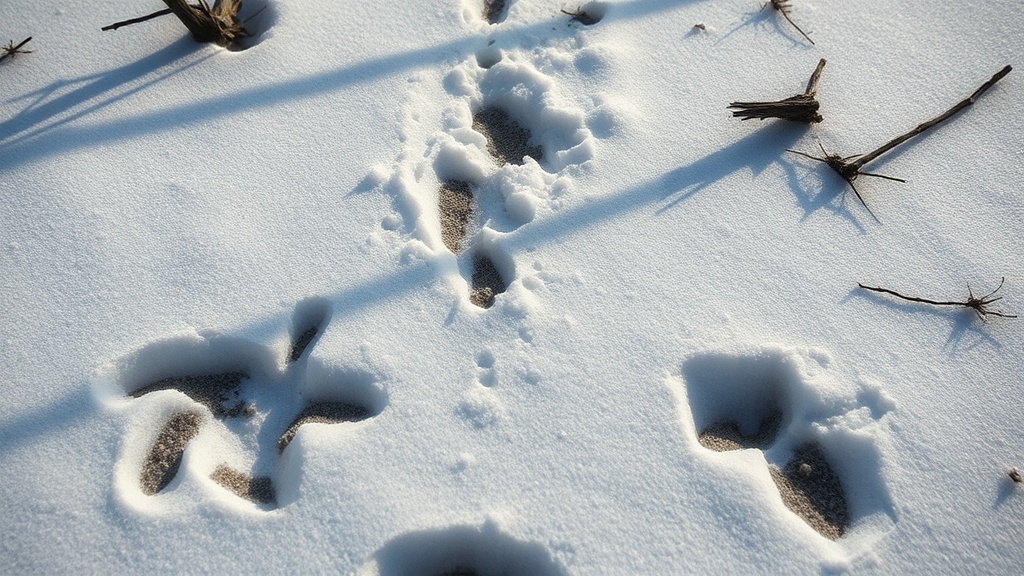
Snow transforms tracking from difficult to effortless. A light dusting reveals everything—mouse highways under shrubs, bird wing prints where they landed, the distinctive waddle of raccoons, the bounding pattern of weasels. Winter hiking becomes a completely different experience when you can read the night's activity written across the white surface. Bring a small ruler or coin for scale in photos, and start a tracking journal. Record what you found, where, the conditions, and your interpretation. Over time, patterns emerge in your local area.
Consider connecting with local tracking communities or attending a workshop. Organizations like CyberTracker Conservation offer certification programs, but local nature centers often host introductory classes. The book "Peterson Field Guide to Animal Tracks" by Olaus Murie remains a classic reference, and NatureTracking.com offers excellent free resources for beginners. Remember—tracking is a skill built through repetition and curiosity. Every track you examine sharpens your eye for the next one.
The forest floor, the snowy meadow, the muddy creek bank—they are all libraries written in a language most hikers never learn. But once you start reading, you cannot stop. That bent grass, that slightly overturned stone, that scuff mark on a log—they all become part of the ongoing story. You will never hike the same way again. The woods open up, reveal their secrets, and welcome you into a deeper relationship with the wild spaces you love.